Page 1 of 2
break in procedure for BB turbo.........?
Posted: July 12th, 2006, 2:03 am
by cjthor
Cant find this ANYWHERE on the net. I guess drive it easy for a tank of gas?
Posted: July 12th, 2006, 3:49 am
by BuGS
just don't run it without a DP and with High Oil pressure like Corksport did to my brother's. 3 rebuilds later and it still leaks cause it needs a new core...
Posted: July 12th, 2006, 11:06 am
by cjthor
BuGS wrote:just don't run it without a DP and with High Oil pressure like Corksport did to my brother's. 3 rebuilds later and it still leaks cause it needs a new core...
oops......Ran it without a DP to make sure it wasnt leaking water...but only for one minute at idle
Posted: July 12th, 2006, 5:28 pm
by BuGS
ya, it isn't the best thing to do. Shouldn't be too bad though. It is the whole thing of when you break it in you want it to be use to so much backpressure/resistence so it wears the bearings a curtain way, cause then when you put the DP on it will wear it differently and then thats when leaks happen... or thats what Garrett told my brother I think... Soemthing along those lines.
Posted: July 12th, 2006, 11:47 pm
by JWMotorsports
The Ballistic, aka "R" series, ball bearing turbos from Garrett have no real breakin needed to my knowledge. The raceways for the bearings are made from extremely ductile materials for ball bearing assembies. The ball bearings are also very tough stainless steel or ceramic and can go for unreal service lifes with virtually no wear as long as you keep them from exceeding there thermal service range. The thermal load is created mostly by the centripical force from the shaft speed and rotating assembly mass. The downpipe will not effect it...we'll unless your breaking out some REALLY expensive equipment you'll never see the differance, probably not even with a dyno. If it would you'd see the journal bearing turbo guys burning up turbos every weekend. That is the key design to Garretts Ballistic CHRA's. By using dual ball bearing assembly's to with stand both rotaional and axial loads they maintain much tighter wheel to housing tolerances and eliminate the need for the thrust bearing normally used in journal bearing turbos. This what both increases the Ballistic turbo's response for much faster spool up and increase efficiency at higher pressure ratio's. The "T" in t-series turbos now stands for "Trash"

Posted: July 12th, 2006, 11:52 pm
by BuGS
Mommy he called my turbo trash!

Posted: July 13th, 2006, 7:43 pm
by Steeb
JWMotorsports wrote:The Ballistic, aka "R" series, ball bearing turbos from Garrett have no real breakin needed to my knowledge. The raceways for the bearings are made from extremely ductile materials for ball bearing assembies. The ball bearings are also very tough stainless steel or ceramic and can go for unreal service lifes with virtually no wear as long as you keep them from exceeding there thermal service range. The thermal load is created mostly by the centripical force from the shaft speed and rotating assembly mass. The downpipe will not effect it...we'll unless your breaking out some REALLY expensive equipment you'll never see the differance, probably not even with a dyno. If it would you'd see the journal bearing turbo guys burning up turbos every weekend. That is the key design to Garretts Ballistic CHRA's. By using dual ball bearing assembly's to with stand both rotaional and axial loads they maintain much tighter wheel to housing tolerances and eliminate the need for the thrust bearing normally used in journal bearing turbos. This what both increases the Ballistic turbo's response for much faster spool up and increase efficiency at higher pressure ratio's. The "T" in t-series turbos now stands for "Trash"
garretts bb gt series turbos might only spool marginally faster than other turbos of similar spec. the fact of the gt series turbos is that faster spool has NOT been proven true. many of the bb gt turbos are very slow spooling because they have garbage a/r's but some are just better paired wheels and housings for better a/r's than the previous t3, t4 or t3/t4 hybrids. turbo spool is greatly affected by a/r, choosing the right turbo combos isnt easy which is why the gt series turbo's with better a/r's sell so well. if you can choose the correct wheels n housings for a proper a/r than your turbo spool be no slower than a gt series turbo of similar size.
jarid, run a little bit of oil thru it then prime the turbo by turning the engine but unplug the ignition fuse so the engine does not start. this will ensure that there is oil in the turbo when u start your engine up.
Posted: July 13th, 2006, 8:17 pm
by cjthor
Steeb wrote:JWMotorsports wrote:The Ballistic, aka "R" series, ball bearing turbos from Garrett have no real breakin needed to my knowledge. The raceways for the bearings are made from extremely ductile materials for ball bearing assembies. The ball bearings are also very tough stainless steel or ceramic and can go for unreal service lifes with virtually no wear as long as you keep them from exceeding there thermal service range. The thermal load is created mostly by the centripical force from the shaft speed and rotating assembly mass. The downpipe will not effect it...we'll unless your breaking out some REALLY expensive equipment you'll never see the differance, probably not even with a dyno. If it would you'd see the journal bearing turbo guys burning up turbos every weekend. That is the key design to Garretts Ballistic CHRA's. By using dual ball bearing assembly's to with stand both rotaional and axial loads they maintain much tighter wheel to housing tolerances and eliminate the need for the thrust bearing normally used in journal bearing turbos. This what both increases the Ballistic turbo's response for much faster spool up and increase efficiency at higher pressure ratio's. The "T" in t-series turbos now stands for "Trash"
garretts bb gt series turbos might only spool marginally faster than other turbos of similar spec. the fact of the gt series turbos is that faster spool has NOT been proven true. many of the bb gt turbos are very slow spooling because they have garbage a/r's but some are just better paired wheels and housings for better a/r's than the previous t3, t4 or t3/t4 hybrids. turbo spool is greatly affected by a/r, choosing the right turbo combos isnt easy which is why the gt series turbo's with better a/r's sell so well. if you can choose the correct wheels n housings for a proper a/r than your turbo spool be no slower than a gt series turbo of similar size.
jarid, run a little bit of oil thru it then prime the turbo by turning the engine but unplug the ignition fuse so the engine does not start. this will ensure that there is oil in the turbo when u start your engine up.
Too late..car is running and working ok. Gonna drive it to work tomorrow and see how it does on the fwy..
Posted: July 13th, 2006, 10:21 pm
by JWMotorsports
Have you ever had the two turbos in hand to compare them? Blow in a gt or t series turbine and blow in a gt "R" series. I'll put money on the "R"series every time that it rotates faster than its journal bearing cousing even if you use identical trims and a/r's. There is less frictional drag and tigher clearances between the wheels and housings in the "R" series turbos...equates to higher efficency, they also use more areodynamic wheels than the "t" series. They have been compared, the "T" series was even given a head start with a SMALLER A/R exhaust housing and both turbos tested on the same dyno with the same car, same setup. Guess which turbo won....the "R" series...kicked the CRAP out of the "t" series on both ends of the rpm range (spooled faster and made WAY more power). My GT3076R (aka 3037R) w/ a .82 A/R exhaust housing makes boost as low as 2500RPMs and really starts making power at 4000RPM with 7.9:1 compression 1.6L B6T with a stock bottom end. My turbo's flow is that of a big t3/60-1 and the t3/60-1 doesn't spool that fast even on a 2.0L 4G63.
Here is dyno proof to back up my statements
http://www.atpturbo.com/root/turbopipin ... gragsr.htm
Posted: July 14th, 2006, 2:16 am
by Steeb
id like to ask if you have you ever had the two turbos mentioned in the link you posted in hand?
the gt28rs on the left and a t3/t4 57 trim. closest picture i could find..
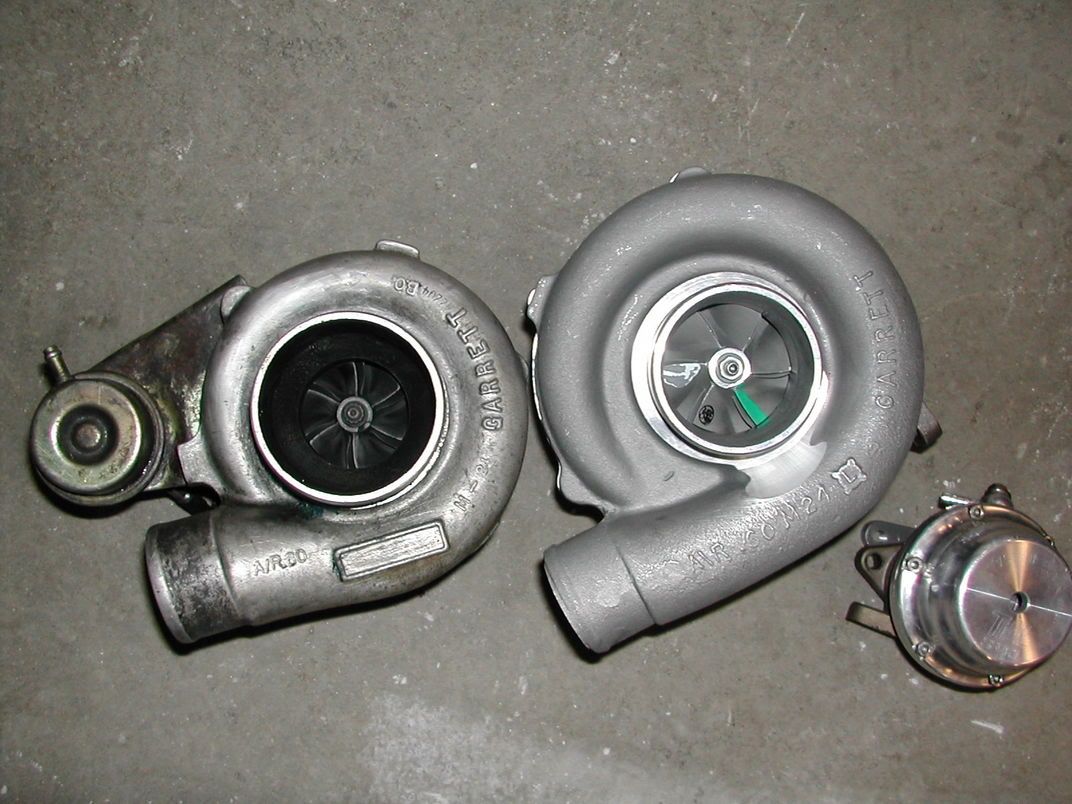
just so everyone that doesnt already know a gt28rs is much smaller than the t3/t4 listed in the link you posted above. the t3/t4 with the .63 a/r turbine housing is larger and capable of more power than the disco potatoe. due to the difference in size and capability, it does spool slower. btw, the gt28rs will be pushing its extreme limits to make just under 300whp where as the t3/t4 will do 400+ 500+.
the link does not state that obviously the same psi was used. the gt28rs dyno was probably nearly twice the boost level that the t3/t4. i wouldnt be surprised to find that the gt28rs is probably running near 18+ psi and the t3/t4 is probably running 10-12psi. it also does not say if timing and fuel were adjusted. its easy to leave out certain details.
im not bagging on the gt turbo's, they are well made and SOME of them are very good. doesnt mean they are all good. garrett got lucky with a few and threw the r or rs badge on them. more power to them for finding a few well matched turbos.
Posted: July 14th, 2006, 2:52 am
by BuGS
Steeb wrote:id like to ask if you have you ever had the two turbos mentioned in the link you posted in hand?
the gt28rs on the left and a t3/t4 57 trim. closest picture i could find..
just so everyone that doesnt already know a gt28rs is much smaller than the t3/t4 listed in the link you posted above. the t3/t4 with the .63 a/r turbine housing is larger and capable of more power than the disco potatoe. due to the difference in size and capability, it does spool slower. btw, the gt28rs will be pushing its extreme limits to make just under 300whp where as the t3/t4 will do 400+ 500+.
the link does not state that obviously the same psi was used. the gt28rs dyno was probably nearly twice the boost level that the t3/t4. i wouldnt be surprised to find that the gt28rs is probably running near 18+ psi and the t3/t4 is probably running 10-12psi. it also does not say if timing and fuel were adjusted. its easy to leave out certain details.
im not bagging on the gt turbo's, they are well made and SOME of them are very good. doesnt mean they are all good. garrett got lucky with a few and threw the r or rs badge on them. more power to them for finding a few well matched turbos.
It is listed that the Disco Potato made 316/266 with 10psi and More Fuel. But what I don't get is why they had to do that. I wonder what PSI they were running on the t3/t4 to only have like 223/193....
Posted: July 15th, 2006, 1:54 am
by Steeb
i hardly believe the gt28rs made that much power with 10psi. it would need more than 10psi with the gt30 to make that much power at the crank.
just go to your favorite search engine and type in the two words "gt28rs dyno" then click on search and images. you will find several dynos that are toping out at 300whp at over 18psi depending on which engine it is installed on.
like i said before 300whp is pushing the gt28rs to its extreme limits. to make that much power your engine better be built to handle over 18psi and probably race fuel or extremely careful tuning with gigantic injectors on pump gas.
t3/t4 depending on trim can make easy 400whp depending on trim.
both lines are from the same car using the same t3/t4 .63 ar 50 trim at 17psi.

here is the same t3/t4 .63ar 50 trim at 22.5 psi.
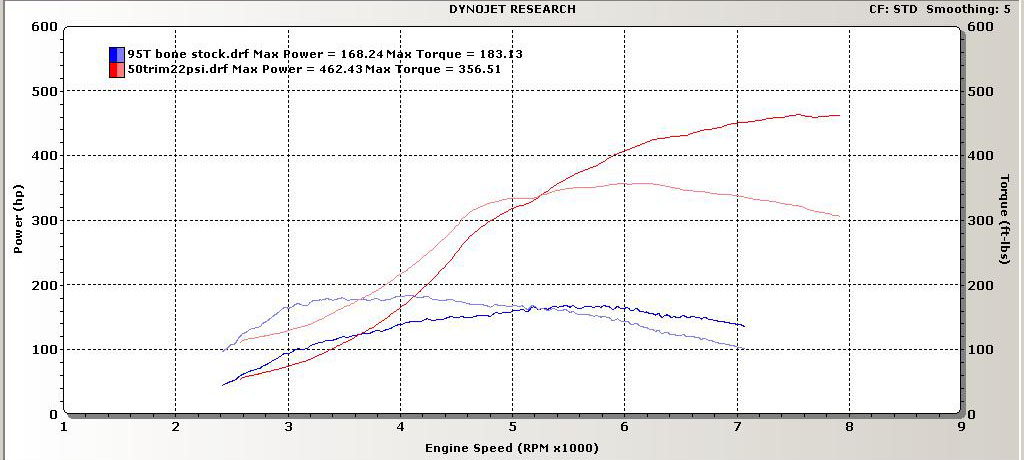
here is a t3/t4 .63 a/r at 17.5 psi btw this is a smaller 46 trim

gt28rs 18psi...

the hks gt28rs on the other hand is not the same as garrett gt28rs. some people have pushed that turbo to the whereabouts of 350-370whp.
since we are comparing turbos here is a gt3071 compared to a t3/t04e. according to garrets website the gt30 is capable of 310 hp-475 hp. if the gt2871 according to garrett is capable of 400hp but in reality not many people will dyno over 290whp at its extreme limits so what can the gt30 produce in reality?
we see the 50 trim t3/t4 making as much power as garrett rates the gt30 while still having more headroom. at the same time the t3/t4 has comparable spool and much greater power potential than the gt2871 even in a weeny 46 trim. the 50 trim, is comparable to the gt3071 in spool and max power output
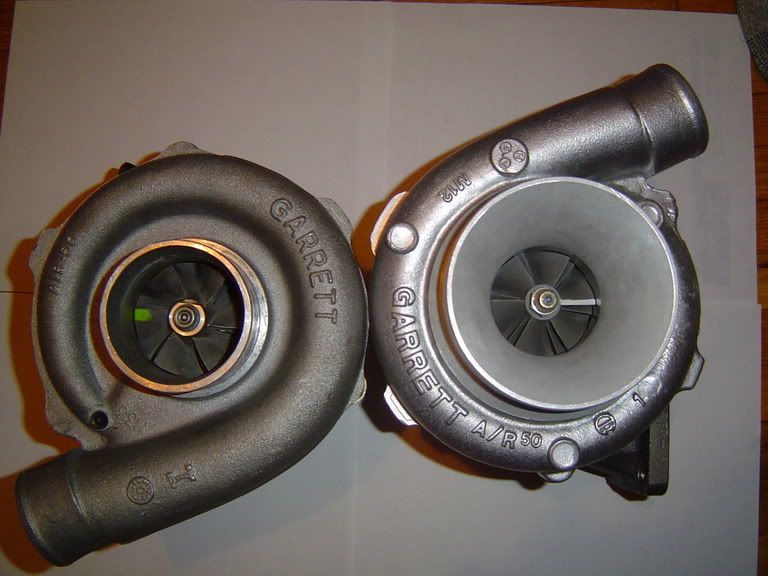
t does not mean trash. need i say more?
Posted: July 15th, 2006, 1:59 am
by JWMotorsports
Make: Acura
Model: Integra GSR
Year: 1993
Induction Model: Garrett GT28RS
Cooling Detail: Front Mounted Intercooler
Old "T" Wheel Horsepower/Torque: 223/193 WHP/Torque
New "GT" Wheel Horsepower/Torque: 279/226 WHP/Torque
ATP implements
"drops-in" the GT28RS on 2nd gen Acura Integra GSR!
We show how easy it is to swap out the old T3/T4 for a more modern Garrett GT Dual Ball Bearing turbo
without changing the major hardware components in the kit. Components
such as exhaust manifold, downpipe, wastegate, intercooler pipiing, and intake piping all retained.
Fuel:
-375cc RC Injectors
-Vortech Fuel Management Unit
-In Line Fuel Pump
Implementation:
1. Dyno existing T3/T4 with fixed boost level. Direct pressure signal to wastegate - no boost controller.
2. Unbolt T3/T4 and swap in GT28RS drop-in.
3. Retain same manifold, wastegate, downpipe, intercooler, and pipingwork.
4. Re-dyno setup with new turbo
Old "T" Turbo: T3/T4E - .63 A/R Turbine Housing
New "GT" Turbo: GT28RS - ATP GT30 T3 Style drop-in - .82 A/R turbine housing
The turbos were tested at the same boost pressure, etc...and it appears with out any additional tuning. They were using an external Tial 38mm gate to control the boost. All they changed was the turbos and added water cooling lines for the GT28RS. The Disco Pot made 316WHP buy just adding fuel. I'm wondering what trim compressor they were using on that T3/TO4E...if it was a 60trim then that would explain the lag and low power out put at 10psi....a 60trim is just starting to blow a lil bit at 10psi and will support 500WHP. Thats the only way you'ld be able to add fuel and gain that much power. That big compressor at 10psi is actually choking the engine as the turbo hasn't spun up to its proper pressure ratio range.
The bottom line:
http://www.turbodynamics.co.uk/ball_bearing.htm
http://www.suprastore.com/balbearturdo.html
I think those last two links say it all.

Posted: July 15th, 2006, 2:13 am
by Steeb
theories are all theories.
benchmark racing is for the weak.
when it comes down to it, proof is in the dyno
Posted: July 15th, 2006, 2:44 am
by Steeb
JWMotorsports wrote: I'm wondering what trim compressor they were using on that T3/TO4E...if it was a 60trim then that would explain the lag and low power out put at 10psi....a 60trim is just starting to blow a lil bit at 10psi and will support 500WHP. Thats the only way you'ld be able to add fuel and gain that much power. That big compressor at 10psi is actually choking the engine as the turbo hasn't spun up to its proper pressure ratio range.
The bottom line:
http://www.turbodynamics.co.uk/ball_bearing.htm
http://www.suprastore.com/balbearturdo.html
I think those last two links say it all.
if the t3/t4 was larger than adding more fuel to a smaller gt2871 would result in less power from running too rich. we all know running a leaner a/f ratio will result in more power than a rich a/f ratio. so by this we can safely say they were making a very bad comparison with the tinyest most inefficient t3/t4 they could find.
also by looking at the t3/t4 tq on the link u listed, you can see that it seriously falls flat on its face after 6000rpms. for a 1.8 engine that has at least 1500 rpms left, that is a very harsh tq drop off. like i said earlier you would have to be using the smallest t3/t4 you could find to have those results on a 1.8. i know for a fact we can safely say the are using a turbo much smaller than a t3/t4 .63 ar 46 trim which IS THE comparable turbo to the gt2871.
...if it was a 60trim then that would explain the lag and low power out put at 10psi....a 60trim is just starting to blow a lil bit at 10psi and will support 500WHP. Thats the only way you'ld be able to add fuel and gain that much power. That big compressor at 10psi is actually choking the engine as the turbo hasn't spun up to its proper pressure ratio range.
if the turbo was infact a larger turbo than it also proves to be a bad comparison because any smaller or more efficient turbo including a smaller gt28rs will spool faster than a larger more inefficient 60trim.
this is why i dont trust comparisons made by companies who do not list complete details when making comparisons. while many companies make good quality products, they are still out to make your money.
to the untrained eye most people will not understand how to tell if a turbo is improperly sized. in this case the t3/t4 in comparison is too small and choking on a tiny 1.8 as we can see by reading the severly falling tq curve.
when it comes down to it comparisons are very one sided and done by companies who want your money.people who are not as well informed do not know how many different t3/t4 combinations there are and assume they are all the same. this is why i listed the dyno comparison for the 46 and the 50 trim t3/t4's. those two are fine examples of how a decently efficient t3/t4 compares to the new gt series. bottom line, do your homework and your t series will perform the way you want.